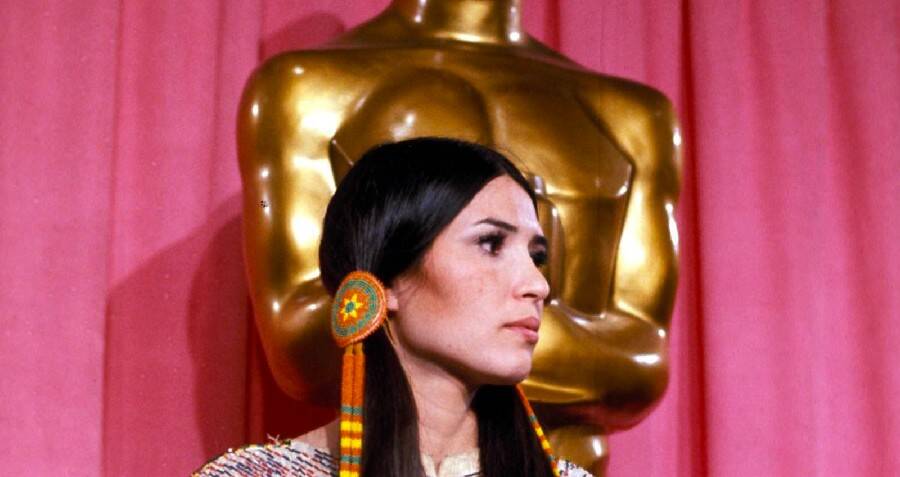
In 1973, when Marlon Brando won the Best Actor Oscar for his role in The Godfather, one of the most shocking moments in Academy Awards history occurred. However, it was not Brando who took the stage, but 26-year-old Native American activist Sacheen Littlefeather.
Amid cheers and boos from the audience, Littlefeather rejected Brando's Oscar. She made a brief statement criticizing the portrayals of Native Americans in Hollywood and expressed that the conflict between Native Americans and federal agents at Wounded Knee in South Dakota had not received media coverage.
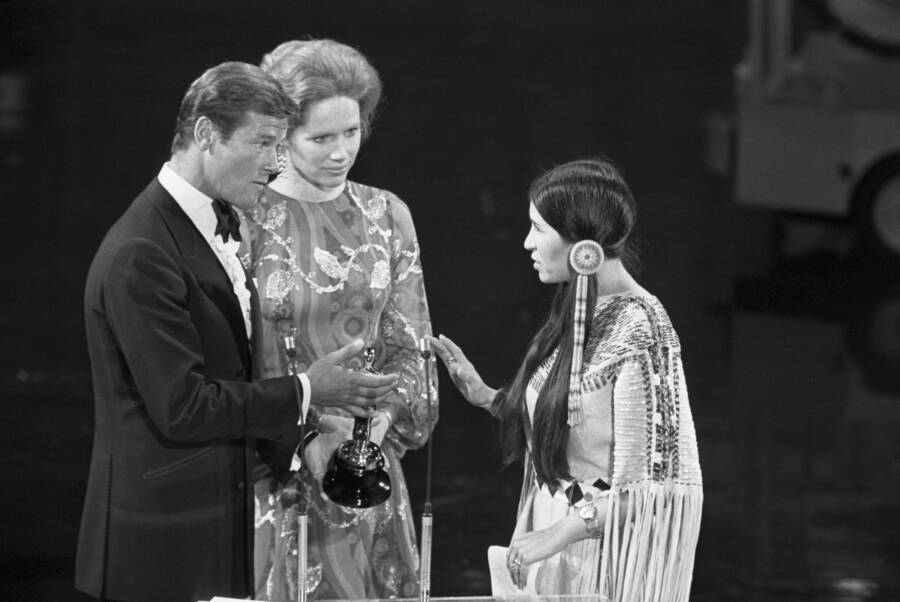
Bettmann/Getty Images Sacheen Littlefeather rejecting Marlon Brando's Oscar in 1973.
Her speech lasted less than 60 seconds but left a lasting impact. Although Littlefeather's career in Hollywood ended prematurely, activists note that she brought attention to the Wounded Knee events and many Native American filmmakers believe her speech profoundly changed the portrayal of Native Americans in Hollywood.
Still, speaking at the Oscars was just one of many brave things Sacheen Littlefeather did in her life.
How Did Sacheen Littlefeather Become an Activist?
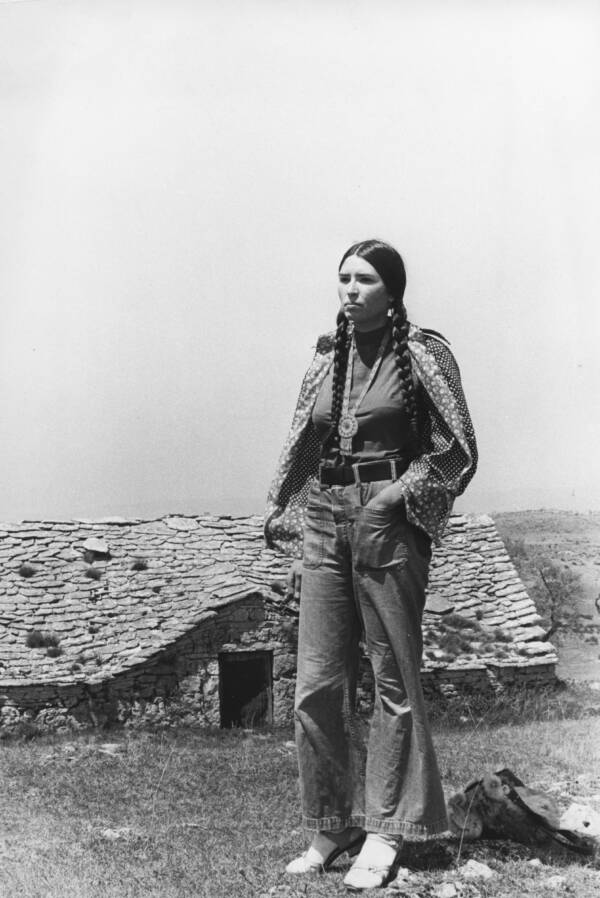
Etienne MONTES/Gamma-Rapho via Getty ImagesSacheen Littlefeather became an activist in her 20s after a difficult childhood.
Born Marie Louise Cruz on November 14, 1946, in Salinas, California, Sacheen Littlefeather was raised by a white mother and a father of White Mountain Apache and Yaqui descent. She later told the Guardian that both of her parents were mentally ill and abusive, and she first became an activist when she defended her mother from her father's beatings.
Raised by her grandparents, Littlefeather often felt like an outsider. According to a Washington Post report, she was bullied for her dark hair and skin, and Littlefeather stated that she was referred to as the “N-word” at the white Catholic school she attended.
“I was very confused about my own identity and I was suffering,” Littlefeather said, noting that she attempted suicide at a young age and was hospitalized. “I couldn't see the difference between my pain and myself.”
However, during her adolescence, Littlefeather began to connect with her Native American roots.
She visited reservations, learned about Native traditions, and witnessed the occupation of Alcatraz by Native American activists in the late 1960s and early 1970s. According to the Washington Post, she joined the American Indian Movement in her 20s and changed her name to Sacheen Littlefeather as a tribute to her heritage.
As an activist, Littlefeather was particularly concerned with the portrayals of Native Americans in popular culture. She was exposed to the kinds of stereotypes she experienced while participating in radio and television projects and campaigned for Stanford University to drop its racist “Indian” mascots.
“In the '70s, there was [the American Indian Movement] and the Native Rights Movement, and I was part of that,” she explained to the Hollywood Reporter. “I was a spokesperson for the stereotypes of Native Americans in film and television. All I said was, ‘We don't want Chuck Connors playing Geronimo.’”
Littlefeather's interest in Native Americans in Hollywood led her to meet her neighbor, director Francis Ford Coppola. According to the Guardian, she heard Brando speaking about Native American rights and wanted to learn if he was “really like that.” After some persuasion, Coppola agreed to bring them together.
Brando and Littlefeather got along well. When the actor was nominated for an Oscar for his role as Vito Corleone in Coppola's 1972 film The Godfather, he approached Sacheen Littlefeather with an idea.
A Turning Point in Oscar History
According to the Washington Post, Marlon Brando approached Sacheen Littlefeather the day before the 1973 Academy Awards and suggested that she reject his Oscar if he won. Brando wanted to protest the portrayals of Native Americans in Hollywood and draw attention to the conflict between federal agents and Native Americans at Wounded Knee.
On Oscar day, March 27, 1973, Littlefeather waited nervously while Brando’s eight-page speech was being written. According to the Guardian, she arrived just minutes before the announcement of the Best Actor winner and was greeted by producer Howard Koch. Koch told her that she would not be able to read Brando’s speech or speak for more than 60 seconds.
“And then everything happened very quickly when it was announced that he won,” Littlefeather said, according to the Guardian. “I had promised Marlon that I would not touch that statue when he won. And I had promised Koch that I would not exceed 60 seconds. So I had to keep both promises.”
First, wearing a buckskin dress and moccasins, with dark hair framing her face, Littlefeather took the stage and refused to accept Brando’s Oscar from host Roger Moore. She criticized Hollywood for its often aggressive and stereotypical portrayals of Native Americans and urged the audience to pay more attention to the Wounded Knee occupation.
“I beg you not to disturb me this evening, and I hope that in the future our hearts and understandings will meet with love and generosity,” Littlefeather said, according to the Los Angeles Times.
Afterward, she recalled that while she was finishing her speech, racist tomahawk gestures were made by the audience and actor John Wayne attempted to rush the stage (some film scholars question this).
Sacheen Littlefeather’s Oscar speech lasted less than 60 seconds. However, it had a profound impact on her life and Hollywood.
Following her appearance at the Oscars, Sacheen Littlefeather found that her budding acting career had come to an end. She was blacklisted by Hollywood studios — or as Littlefeather put it, “red-listed.” Stories circulated that she was a stripper and not truly Native American; Brando later expressed regret for putting her in a vulnerable position.
“I’m sorry that people booed and whistled, maybe that was on me,” she said a few months later on the Dick Cavett Show, according to the Los Angeles Times. “At the very least, they should have shown him the courtesy of listening.”
Debates Over Native American Heritage
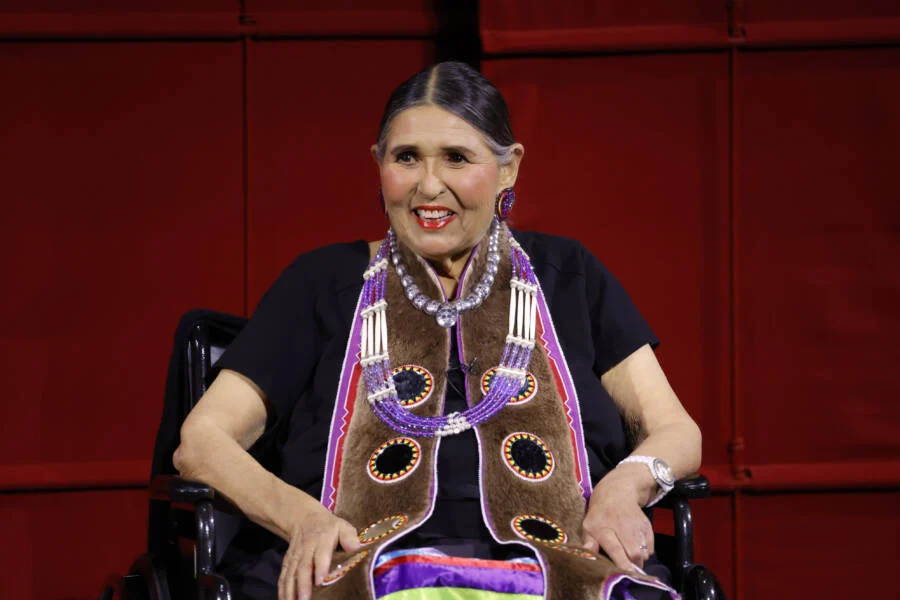
Frazer Harrison/Getty ImagesSacheen Littlefeather, shortly before her death from breast cancer in September 2022.
Littlefeather largely stepped out of the public eye after her Oscar appearance, but continued her activism career. She dedicated herself to combating Native American unemployment, alcoholism, and AIDS.
However, debates continued over Littlefeather’s claims of Native American heritage. In 2022, investigative journalist Jacqueline Keeler from the Navajo and Yankton Dakota Sioux tribes published a list of 200 individuals who she claimed were falsely portraying their Native ancestry for personal gain. Sacheen Littlefeather was included on that list.
“When I examined the family tree of her father, who she claimed had Native heritage, I found no documented connection between his extended family and the existing Native American nations in the United States,” Keeler wrote in the San Francisco Chronicle in 2022.
Littlefeather’s own sisters, Trudy Orlandi and Rosalind Cruz, told Keeler that their family “never claimed this heritage while growing up.” They also added that Littlefeather’s story of a poor childhood was fabricated. They stated that Littlefeather appropriated her father’s own childhood story and made it her own.
“My father was deaf and lost his hearing due to meningitis at nine years old,” Cruz said. “He was born into poverty. His father, George Cruz, was an alcoholic, abusive, and would beat him. And he was placed in foster care and with relatives. But my sister Sacheen took what happened to him.”
However, Keeler’s research was questioned by other Native journalists. At least four individuals were reported to have proven their genuine Native heritage.
Additionally, journalist Laura Clark from the Muscogee and Cherokee tribes also questioned Keeler's process. She added that documents to prove tribal status are not always easily obtainable, largely due to the systematic erasure of Indigenous peoples.
“What many people do not understand about Indigenous existence is that some Native Americans are not registered,” Clark wrote for Variety. “Some Native Americans are reconnecting with their tribes. Some Native Americans do not have enough ‘Native blood’ to register… And some Native Americans’ tribes are nearly erased, so organized citizenship records are not available.”
She also added that citizenship requirements vary from tribe to tribe. The tribes that Littlefeather claimed have not made a public statement on the matter, according to this publication.
Where is Sacheen Littlefeather Today?
Yet, in 2022, nearly 50 years after Brando rejected his Oscar, the Academy officially apologized to Sacheen Littlefeather for the reaction to her speech and the mistreatment she endured in the years that followed.
“The emotional burden you have endured and the damage it has done to your career in our industry is irreparable,” former Academy President David Rubin wrote to Littlefeather, according to CNN. “The courage you showed has been overlooked for far too long. We offer our deepest apologies and our heartfelt admiration for this.”
Sacheen Littlefeather accepted the apology and humorously noted that Native Americans are “patient” and use humor to survive. Shortly before her passing from breast cancer on October 2, 2022, Littlefeather said that when she stepped onto the Oscar stage in 1973, she made a simple yet sincere request.
“All we wanted, what I wanted, was to say, ‘Hire us. Let us be ourselves. Let us play ourselves in films. Let us be a part of your industry, be producers, directors, writers,’” she said. “‘Don’t write our stories for us. Let us write our own stories. Let us be who we are.'”
Comments
(6 Comments)