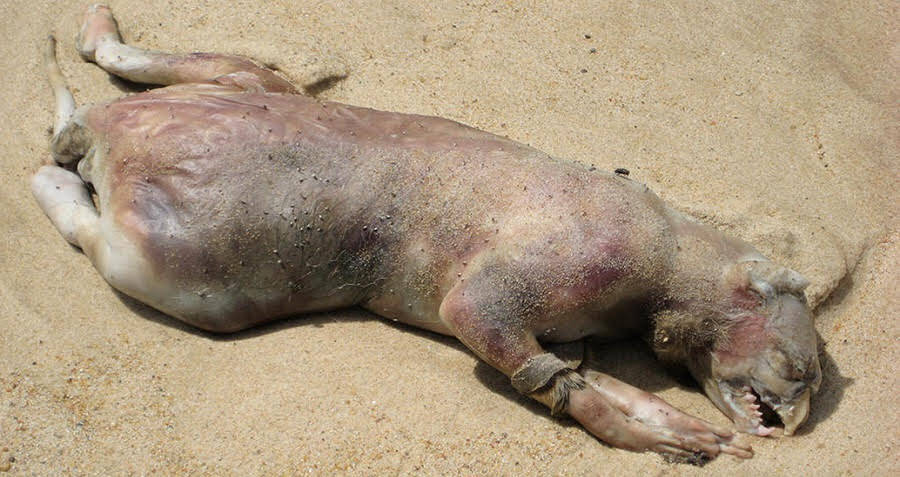
In July 2008, a strange creature washed ashore in the Long Island area of New York. This bloated, blood-drained monster, lying dead on Ditch Plains beach, was quickly dubbed the "Montauk Monster."
News about the monster and theories about its origins spread rapidly. Some suggested it could be the mutant result of an experiment conducted at the nearby Plum Island Animal Disease Research Center, while others claimed it was an alien. Or perhaps it was just a bizarre prank.
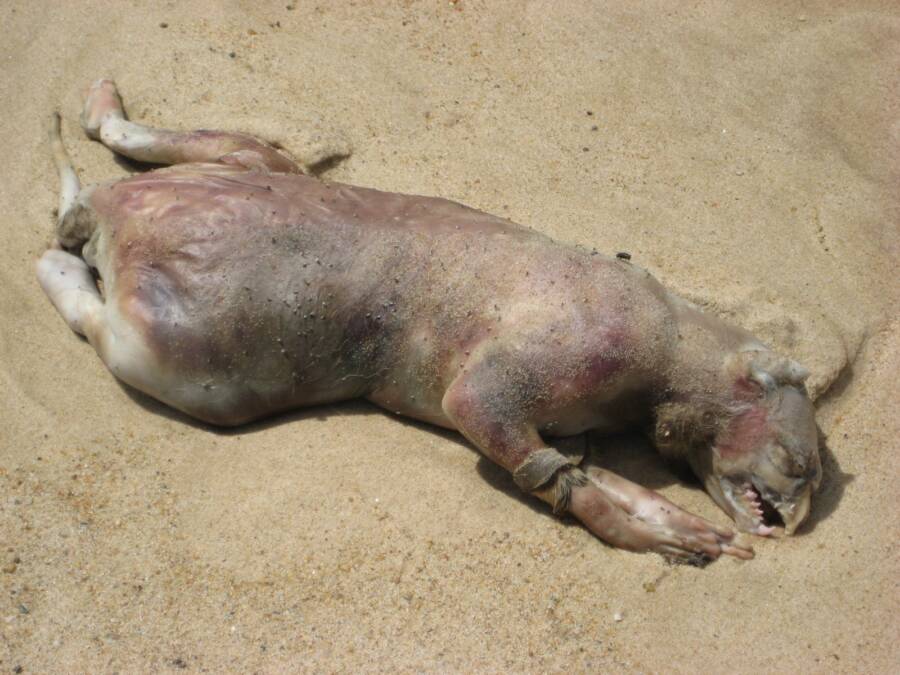
Wikimedia CommonsIn July 2008, the body of a mysterious creature known as the Montauk Monster washed ashore in Long Island - and experts have been baffled ever since.
Loren Coleman, director of the International Cryptozoology Museum, known for coining the name "Montauk Monster," soon initiated a comprehensive investigation into this strange creature.
As an expert in the controversial existence of animals, Coleman seemed like a perfect candidate for the job - if only the Montauk residents could speak with him. Coleman noted oddly, "These people have built a brick wall around themselves." Before long, the creature disappeared and the trail went cold.
To this day, a series of chilling questions remain: What was the Montauk Monster? Where did it come from? Were the residents silenced?
Here lies the enduring mystery behind the Montauk Monster.
The Montauk Monster Washes Ashore and Shocks Onlookers

YouTubeCourtney Fruin (left) and Jenna Hewitt (right) recount the moment they discovered the Montauk Monster.
On July 12, 2008, Jenna Hewitt went to Ditch Plains beach with her friends Rachel Goldberg and Courtney Fruin. It was an ideal day for hiking on a hot summer Saturday, but this East Hampton group encountered a heart-stopping sight as they continued.
The creature, resembling a sun-dried dog carcass, had strange ligaments on its legs. However, it did not seem large enough to be a dog, and instead of a mouth, the creature had a beak. Hewitt took a photo of the dead animal - this photo quickly spread across the internet.
The East Hampton Independent was the first media outlet to report this strange discovery. Their story published on July 23, titled "Bonacville's Hound," caused local waves - this title referenced the nearby "Bonackers" area and Sir Arthur Conan Doyle's The Hound of the Baskervilles.
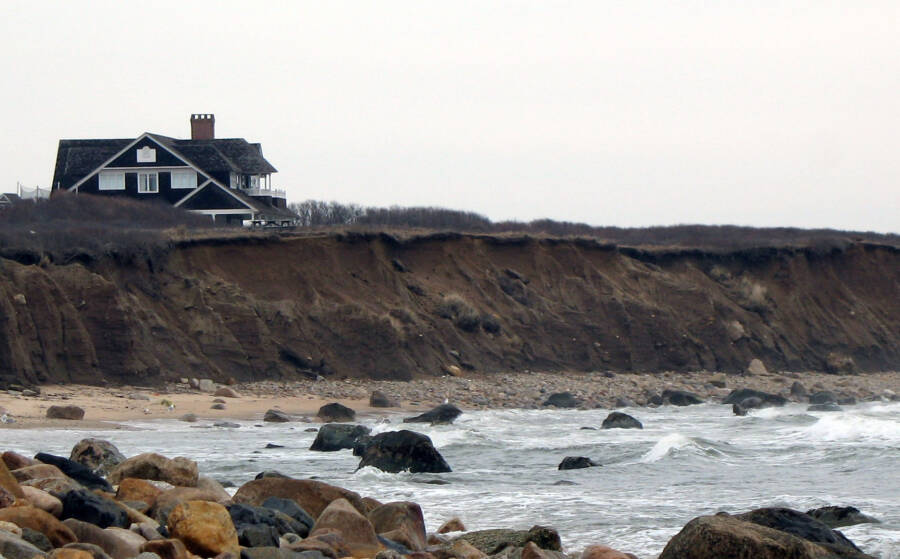
Wikimedia CommonsDitch Plains, particularly on a closed afternoon.
However, things really picked up when Gawker published a blog post titled "Dead Monster Washes Ashore in Montauk" on July 29.
The 87-word piece was filled with sarcasm and heavily implied that the Montauk Monster was a marketing stunt, but the strange photo had an impact, and the story made it to the national stage, appearing in publications like Fox News and The Huffington Post.
Conspiracy theorists worldwide took notice, and Coleman, knowledgeable about strange animal discoveries, was among those wanting to learn more.
However, when Coleman arrived in New York, the creature's body was nowhere to be found. Apparently, someone had deliberately removed it - which raised concerns among suspicious onlookers.
Investigating the Montauk Monster Raises More Questions
Coleman did not get to see the creature with his own eyes. According to a local source, the creature had decomposed to the point of being unrecognizable, saying, "Now there’s just a skull and bones." He then took a "man" corpse that Hewitt refused to identify to the woods next to her home.
Since then, Hewitt has reportedly refused to give any more interviews.
Meanwhile, it is claimed that the three young women who found the monster have also disappeared from the media. Coleman was left with very few clues to work with.
Locals who saw the decomposed body stated that it was no larger than a cat, and conclusions about its origin and identity had to be theoretical by now.
As a result, some experts began to consider the situation a prank. William Wise, director of the Stony Brook University Living Marine Resources Institute, stated that the creature was likely a coyote or dog that had been in the water for a while.
He added that the creature was probably not a rodent, sheep, or raccoon. Others suggested that the creature was a turtle without a shell, but Wise disagreed. Turtles do not have teeth, while the Montauk Monster definitely had teeth.
On the other hand, rumors spread that the monster was a mutant that escaped from the Animal Disease Research Center on Plum Island. Local cable reporter Nick Leighton stated that he spoke with the women and joked about the Plum Island story during their conversations on July 31, with Goldberg showing him an alternative photo of the creature taken from a completely different angle.
Two years after the Montauk Monster scandal, Leighton visited the Plum Island facility. He reported that the security was so tight that nothing seemed likely to escape.
Leighton noted that he had to obtain government approval to go with a TV crew, and the crew was not allowed to take anything from the facility, not even an opened bottle of water.
Then, Leighton found a clue that could potentially solve this strange mystery.
What Could the Montauk Monster Have Been? The Mystery Continues
During his research, Leighton heard rumors that a dead animal was honored with a Viking funeral; during this funeral, the animal was burned and sent to sea in flames. It was possible that the "honored" creature had washed ashore burned and misshapen at Ditch Plains.
This theory was further supported by an unidentified local who told journalist Drew Grant that he found a dead raccoon on nearby Shelter Island at the end of June 2008.
"This creature was honored with a Viking funeral; it was not just researched for crude entertainment," he said. "In terms of a full explanation, this happened shortly after a water torture endurance contest and just before a clothes hanger contest among friends."

Wikimedia CommonsThe most plausible explanation for the dead raccoon found on Shelter Island appears to be a Viking funeral.
As a result, it turns out that the creature was a dead or burned mammal. Indeed, Discovery officially suggested that the Montauk Monster was likely a raccoon.
As for the ligaments on its legs, a sad theory suggests that the Montauk Monster could have been a pit bull, a fighting dog, that was fatally injured or killed here. Then, it washed ashore at Ditch Plains after being burned in the sun for two weeks and becoming unrecognizable.
Coleman even accepted this explanation. According to him, the Montauk Monster does not belong in the same category as the Yeti and is probably a raccoon.
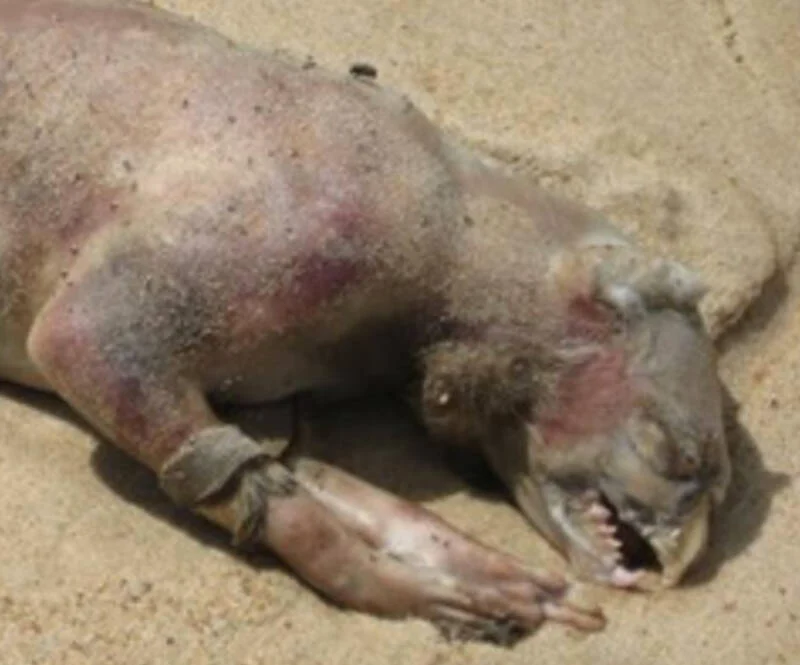
Wikimedia CommonsThe features of the Montauk Monster resemble those of a raccoon, but some remain unconvinced that this explanation is so simple.
However, the corpse was never examined or tested, and of course, the "burned dead raccoon on the shelf" theory remains controversial. Some insist that the creature was something entirely different.
Indeed, the isolated tip of Long Island has hosted other alleged supernatural events, such as the Montauk Project, which is said to have conducted time travel experiments at Montauk Air Force Base.
When Ellen Killoran wrote about the Montauk Monster for the Observer in 2008, an acquaintance told her that Montauk was "a place with many secrets."
For journalist Drew Grant, there is nothing but acceptance that the Montauk Monster legend will remain unsolved: "This will be one of those mysteries forever."
























Comments
(5 Comments)