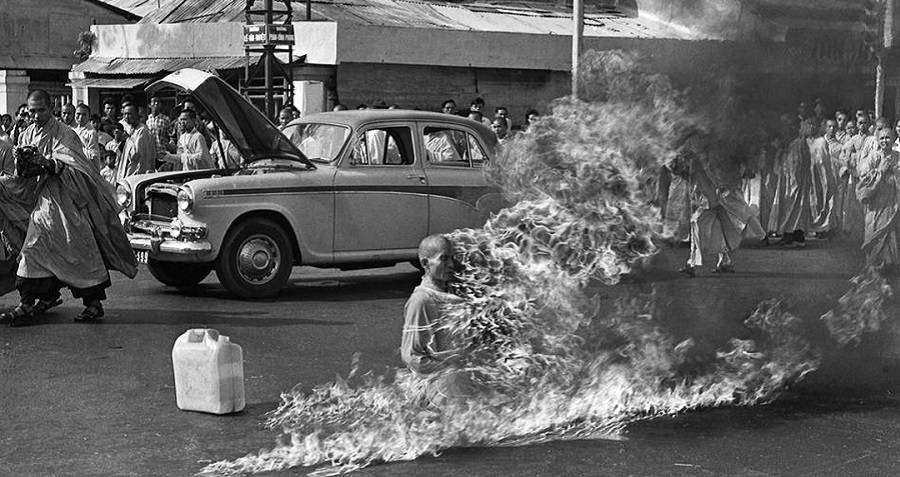
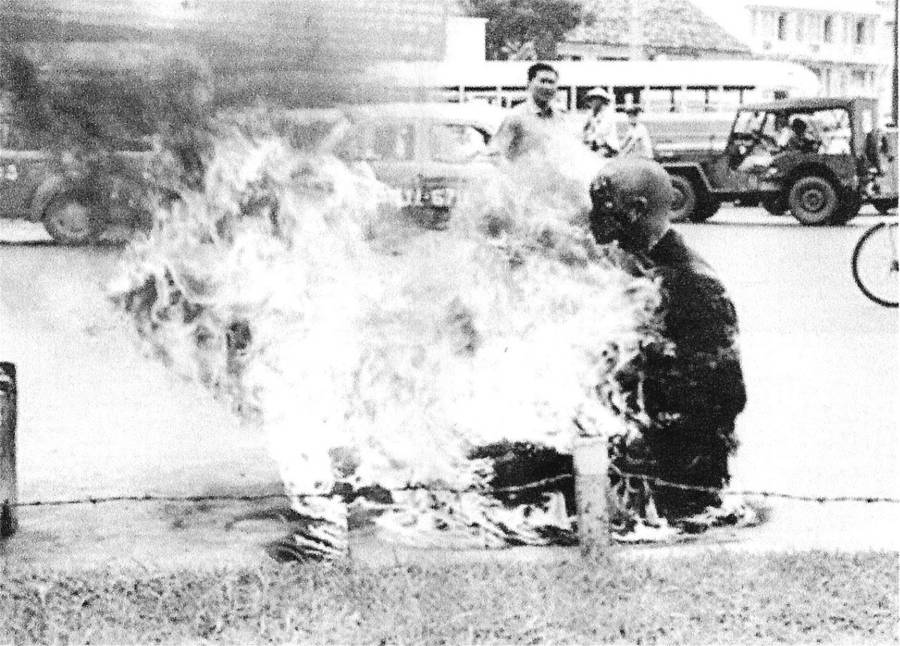
“No news photograph in history,” John F. Kennedy once said, “has generated as much emotion in the world.”
This was no exaggeration. When the Vietnamese Buddhist monk Thích Quảng Đức set himself on fire on the streets of Saigon on June 11, 1963, it triggered a chain reaction that forever changed the course of history.
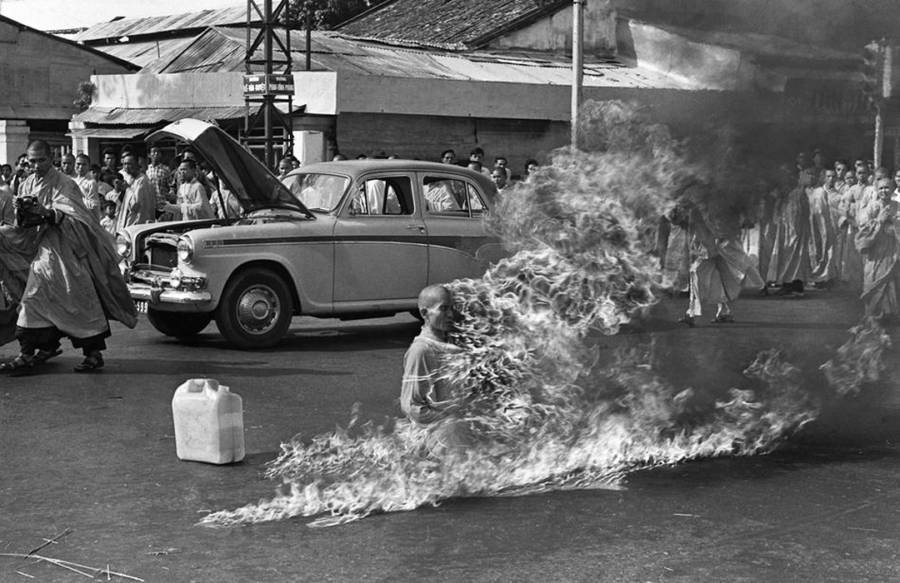
Malcolm BrowneThích Quảng Đức's self-immolation in Saigon. June 11, 1963.
The protest made front-page news in nearly every country. For the first time, the word “Vietnam” was on everyone's lips; until that day, most Americans had never even heard of this Southeast Asian country hidden on the other side of the world.
Today, the “Burning Monk” photo of Thích Quảng Đức has become a symbol of rebellion and the fight against injustice. However, despite its fame, very few people in the West truly remember what Thích Quảng Đức was protesting against.
Though his death was reduced to a symbol, it was much more than that. It was an act of rebellion against a corrupt government that had killed nine of its own people. It ignited a revolution, toppled a regime, and perhaps even led to America’s entry into the Vietnam War.
Thích Quảng Đức was not just a symbol; he was much more than the “Burning Monk.” He was a man willing to give his life for a cause — and he was a man who changed the world.
Nine Dead in Vietnam
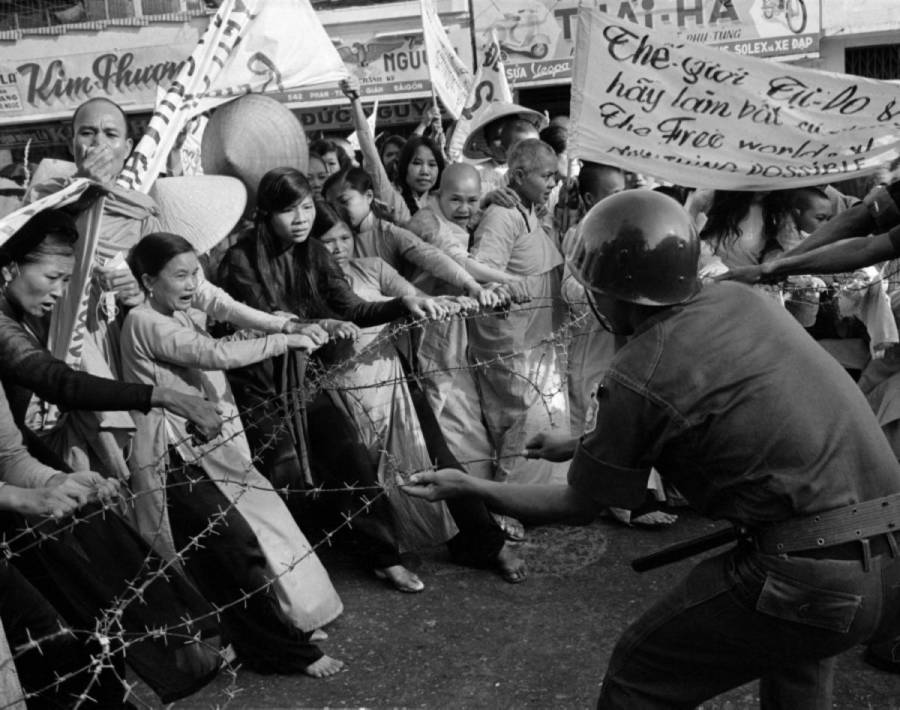
Manhai/FlickrBuddhist protesters erecting barbed wire while clashing with police in Saigon, South Vietnam. 1963.
The story of Thích Quảng Đức begins on May 8, 1963, during a Buddhist celebration in the city of Hue. It was Gautama Buddha's birthday, and over 500 people took to the streets waving Buddhist flags.
However, this was a crime in Vietnam. Despite more than 90% of the country being Buddhist, President Ngo Dinh Diem, a Roman Catholic, had enacted a law prohibiting anyone from displaying a religious flag.
Complaints about Diem's discrimination against Buddhists were growing nationwide, but on this day they had their evidence. Just weeks earlier, Diem had encouraged Catholics to wave Vatican flags during a celebration for a Catholic bishop. But now, as Buddhists filled the streets of Hue with their flags, Diem sent in the police.
The holiday turned into a protest, and a growing crowd took to the streets demanding equal treatment for Buddhists. The army was sent in with armored vehicles to restore peace, but things spiraled out of control.
After a while, shots were fired into the crowd. Grenades were thrown, and vehicles plunged into the crowd. When the crowd dispersed, nine people were dead — two of whom were children crushed under the wheels of armored personnel carriers.
Thích Quảng Đức's Self-Immolation
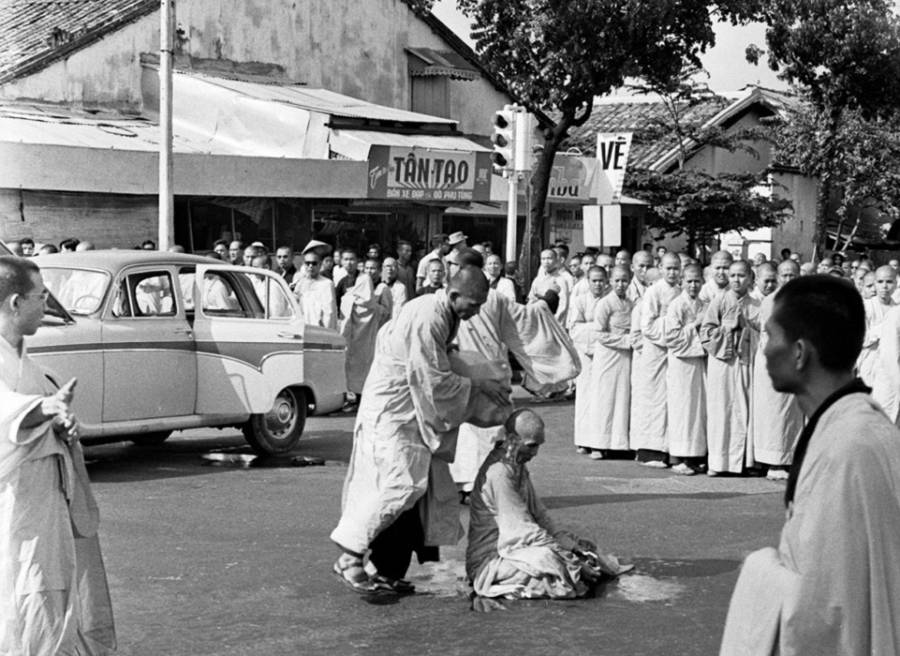
Manhai/FlickrThích Quảng Đức calmly sits as he pours five gallons of gasoline over his head. Saigon, South Vietnam. June 11, 1963.
On June 10, Malcolm Browne, the Saigon bureau chief for the Associated Press, learned that something “significant” would happen in front of the Cambodian Embassy. He believed it.
Things had been heating up in South Vietnam since the massacre. Buddhists had issued a five-point list of demands for religious equality and justice for the dead, and they knew they were willing to do anything to improve their lives.
Browne met Thích Quảng Đức, a Buddhist monk who had lived completely alone in the mountains of Vietnam for three years as a holy hermit. He followed him and a procession of 350 monks and nuns as they made their way toward the center of Saigon, where Duc sat on a simple mat at a busy intersection.
Thích Quảng Đức had a five-gallon can of gasoline with him. As he sat on the mat, his legs crossed, he appeared to be deep in meditation; a monk took the can and poured every drop over the heads of the monks. He was soaked in gasoline, remained calm, and continued to turn the beads around his neck while reciting a prayer to Amitābha Buddha.
“At that moment, I understood exactly what was happening,” Browne would later say. He quickly began taking photographs.
Until that moment, no one had noticed that Thích Quảng Đức was holding a match. The last words of his prayer escaped his lips, and then he struck the match. He dropped the match onto his own clothes, and in an instant, his entire body was engulfed in flames.
The crowd panicked and scattered. The screams of people were cut short by a monk shouting into a microphone: “A Buddhist monk is setting himself on fire! A Buddhist monk is becoming a martyr!”
A fire crew was trying to make its way through the crowd. They were desperately shouting to each other, discussing ways to extinguish the fire without killing Duc. But they would never have a chance to try. The monks lay down in front of the wheels to try to save Thích Quảng Đức.
The only calm person was Thích Quảng Đức himself. “He didn’t move a muscle or make a sound,” recalled a witness as his body burned. For ten minutes, he was just like a match burning on the ground. Finally, his body collapsed.
“I don’t know exactly when he died,” Malcolm Browne said later. “He didn’t scream in pain.”
The Raid on the Pagoda
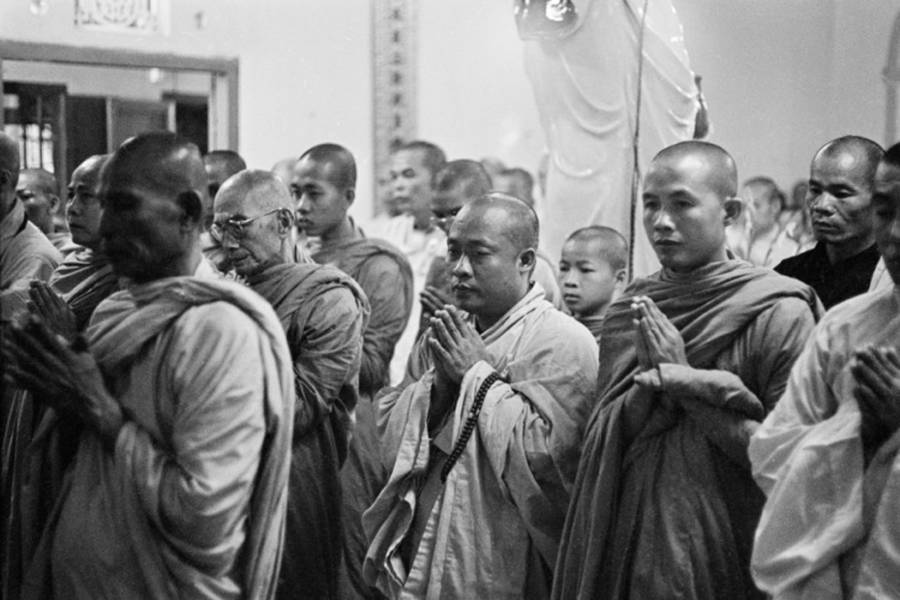
Manhai/FlickrMonks praying for Thích Quảng Đức at the pagoda. Saigon, South Vietnam. June 11, 1963.
When the fire was extinguished, the monks covered Thích Quảng Đức's body with yellow robes, placed him in a wooden coffin, and carried him back to the pagoda.
The body of the “Burning Monk” did not go alone. Thích Quảng Đức came with 350 people, but as he left the stage, more than 1,000 followed him — some were monks, some civilians, and some were police officers who had been persuaded to abandon their posts.
At the pagoda, his body was cremated. At 6:00 PM, the pagoda was surrounded by police. They arrived in armored vehicles, rifles in hand and wearing riot gear, and attacked the monks inside. Thirty-six were dragged out, arrested, and eventually accused of holding a prayer meeting on the street.
But it was too late. The photo of Thích Quảng Đức's self-immolation had already made its way to America. Malcolm Browne had sent the photo via a secret passenger he called the “pigeon” — a film roll secretly carried inside the plane. By morning, Thích Quảng Đức’s burning body would appear on the front pages of newspapers worldwide.
The “Burning Monk” photo would change the course of history — but as Browne would later say, this was nothing compared to the experience of being there. The “Burning Monk” photo had lost “the smell of gasoline and diesel and the smell of burning flesh” and “the cries and agony of the monks in his ears.”
The World-Changing “Burning Monk” Photo
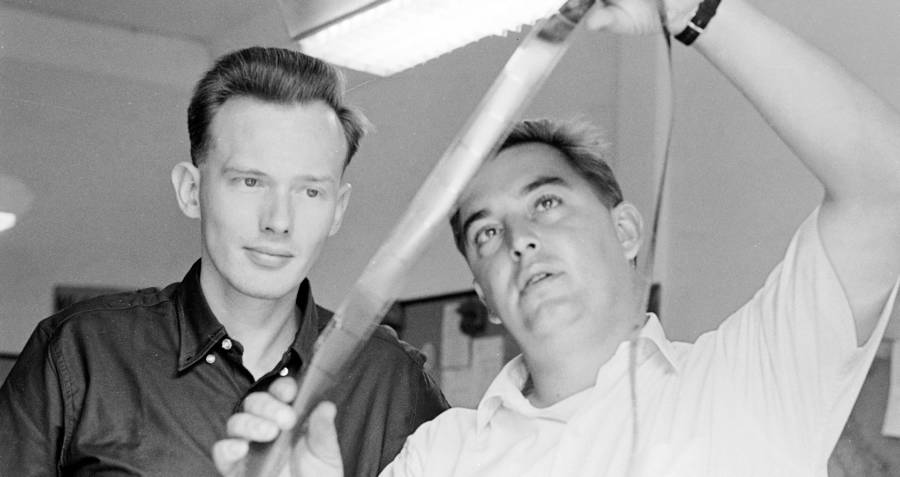
Manhai/FlickrOn the right, Malcolm Browne helps an AP photographer examine a roll of film in Saigon. April 3, 1964.
Despite all its impact, President John F. Kennedy's initial reaction upon seeing the burning body of Thích Quảng Đức was much simpler. According to reports, when the “Burning Monk” photo fell on his desk, the president merely whispered, “Jesus Christ!”
Suddenly, the problems of Vietnam were no longer just their problem. It was an international incident.
President Diem had initially planned to do very little and hoped the Buddhist crisis would resolve itself — but the Americans would not allow that. The U.S. Ambassador to Vietnam began pressuring Diem to meet the Buddhists' demands, and Secretary of State Dean Rusk directly threatened to publicly condemn him if he did not.
Diem bowed to American pressure — but that was not enough for many. It was believed he had no plan to fulfill his promises to resolve the Buddhist crisis.
Moreover, his family's indifference to Thích Quảng Đức's death turned the public against him. Rumors spread that Diem's sister, Madame Nhu, joked that she would “applaud when she saw another barbecue show,” and many believed Diem was complicit.
Diem proved the skeptics right. By sending his special forces to the pagoda where Thích Quảng Đức's ashes were kept, he attempted to steal the remains of the dead man. Two monks managed to escape with the urn containing the man's remains, but the special forces got the bigger prize: the miraculously unburned heart of Thích Quảng Đức.
A Spark that Toppled a Government
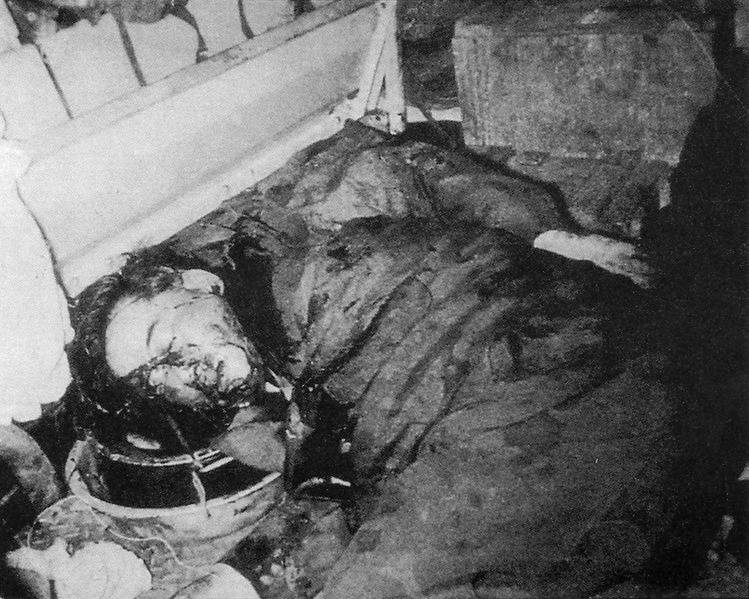
Wikimedia CommonsPresident Diem's body lying in the back of an armored vehicle. Saigon, South Vietnam. 1963.
After the “Burning Monk” set himself on fire, President Diem's days were numbered. Vietnamese nationalists, led by General Duong Van Minh, began making plans to overthrow him, and America supported them. General Minh met with CIA agents, encouraged them, and they promised not to interfere with him.
Diem would not live to see the New Year. On November 1, 1963, Minh and the conspirators attacked. They encountered very little resistance. Only a few found the courage to support Diem.
Diem and his brother tried to escape through a secret underground passage in a Catholic church, but they could not get far. They were found before sunrise, dragged to an armored vehicle, and shot dead.
With a single spark, Thích Quảng Đức helped to topple a government.
Thích Quảng Đức's Legacy, the Burning Monk
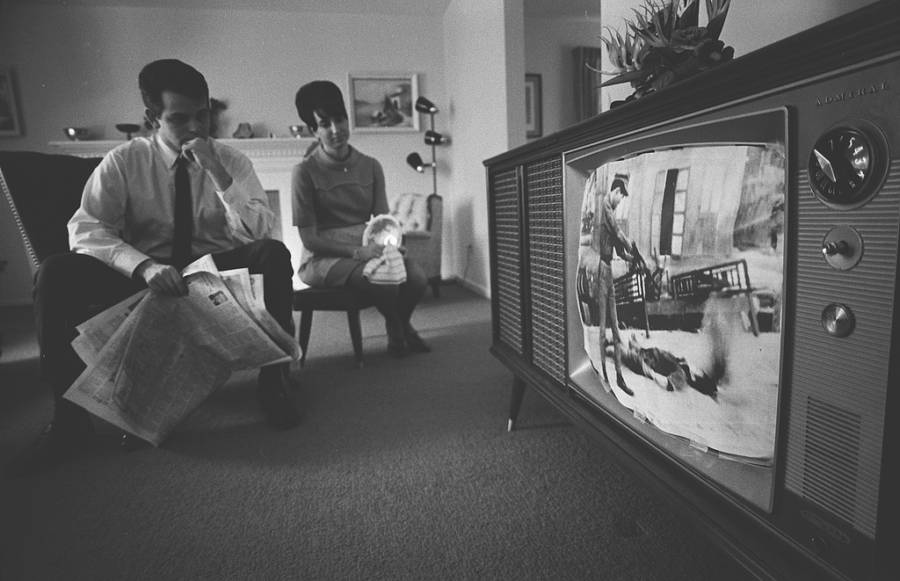
Wikimedia CommonsAs the war began, images of Vietnam became a regular part of American life.
Today, the “Burning Monk” photo is remembered as a symbol of rebellion and resistance — but perhaps it signifies more than that. Thích Quảng Đức's burning body was not just a symbol. According to one advisor, it was “the spark that ignited a series of crises” that brought America into the Vietnam War.
North Vietnam took advantage of the chaos that emerged after the self-immolation and Diem's overthrow. In response to Diem's death, Ho Chi Minh said, “I can’t believe the Americans could be so stupid,” and the conflict between the two countries escalated. Within two years, America would enter the Vietnam War.
Wikimedia CommonsAnother monk set himself on fire on the streets of Saigon on October 5, 1963, following in Quang Duc's footsteps.
Elsewhere, Thích Quảng Đức ignited something in people around the world. Five more Buddhists in Vietnam followed in his footsteps and set themselves on fire.
And on the other side of the world, five Americans, also protesting the Vietnam War that Thích Quảng Đức had unwittingly drawn them into, set themselves on fire. These protests would also have an effect, and over time, America would emerge from the war in defeat.
This was a chain reaction whose effects are still felt today; it all began with a single spark ignited by a monk sitting on a mat in the streets of Saigon. Whether intentional or not, Thích Quảng Đức's death changed not just one life, but the entire world.

Comments
(7 Comments)