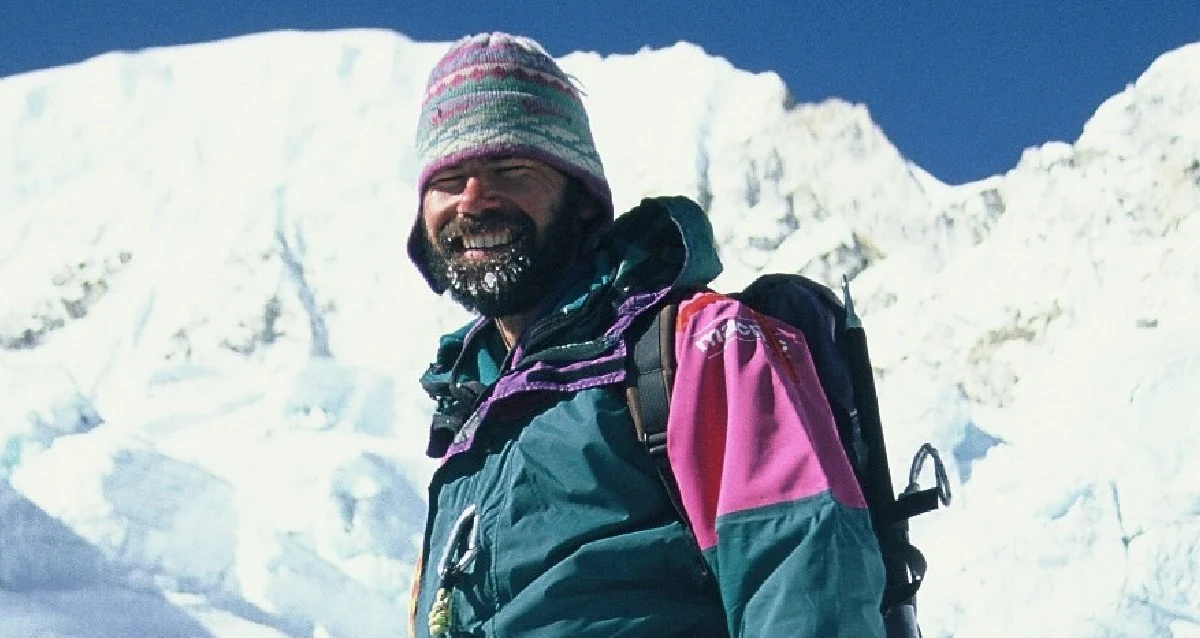
Rob Hall was always a mountaineer.
Starting climbs at a young age in New Zealand's Southern Alps, Hall quickly turned to more challenging mountains. He climbed his first Himalayan peak at the age of 19. At 20, he set a speed record while climbing Mount Cook. Hall would go on to climb the Seven Summits and impressively summit Mount Everest four times.
However, Hall's love for mountaineering would take a tragic turn in 1996. That year, while leading a group of climbers up Mount Everest, Hall found himself stranded on the mountain in the midst of a severe storm. Choosing to stay with another climber, Hall lost his life at the summit at the age of 35.
This is the story of the life and death of climber Rob Hall, who perished during the 1996 Everest Disaster.
How Did Rob Hall's Love for Mountaineering Begin?
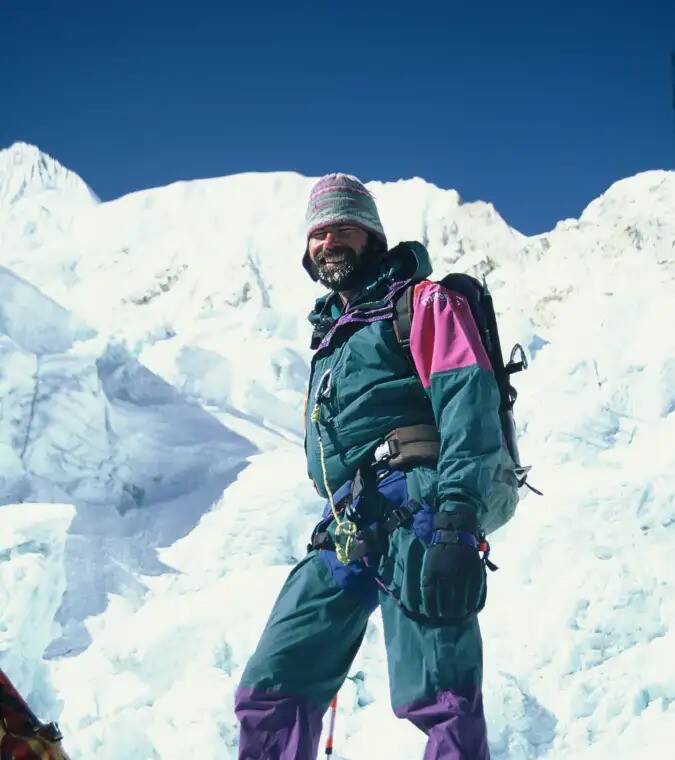
Adventure ConsultantsRob Hall, 1992.
Born on January 14, 1961, in Christchurch, New Zealand, Robert Edwin Hall discovered his love for mountaineering at a young age. Growing up in the shadow of New Zealand's Southern Alps, Hall quickly began to explore the mountains around him. According to Hall's memory in the Independent, he left school at the age of 14 to design climbing equipment for a local sports company while continuing to develop his climbing skills.
In 1980, at the age of 19, Hall climbed Ama Dablam in Nepal. The following year, Hall and a climbing partner made a record ascent of the Caroline Face of New Zealand's Mount Cook. However, his mountaineering career truly gained momentum in the 1990s.
In 1990, Hall made his first ascent of Mount Everest alongside climbing partner Gary Ball and Edmund Hillary's son, Peter Hillary. That same year, he completed the Seven Summits and climbed K2, the world's second-highest mountain, in 1994, and Cho Oyu, the world's sixth-highest mountain, in 1994 and 1995. Furthermore, Hall returned to Everest three more times in 1992, 1993, and 1994.
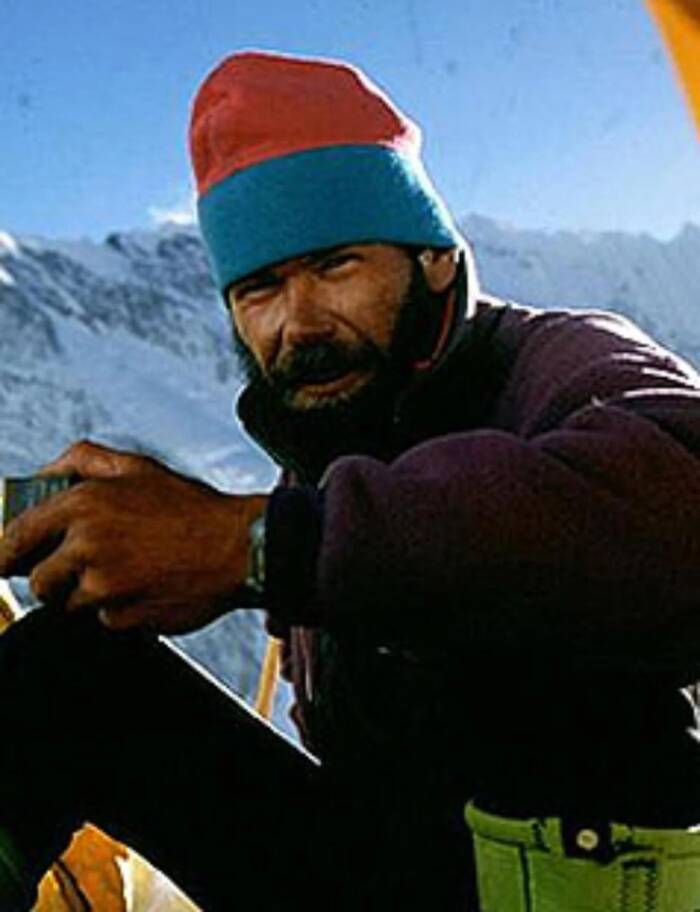
Adventure ConsultantsRob Hall's mountaineering achievements were legendary and quickly led him to establish his own climbing business with his friend and climber Gary Ball.
During this process, Hall and Ball established their own guiding business in 1991: Adventure Consultants. In 1992, they organized the first commercial guided expedition to Mount Everest, reaching the summit with six clients and four Sherpas.
The following year, tragedy struck; Ball died of pulmonary edema while climbing Dhaulagiri in the Himalayas with Hall in 1993. Hall had to bury his friend on the mountain slopes, but despite the traumatic event, he continued to run the company alone.
In May 1996, Rob Hall was preparing to lead a group of clients up Mount Everest. Each had paid $65,000 for the privilege, and there was little reason for concern. After all, Hall had climbed the mountain four times before.
But disaster was waiting for them.
The Inside Story of the 1996 Everest Disaster
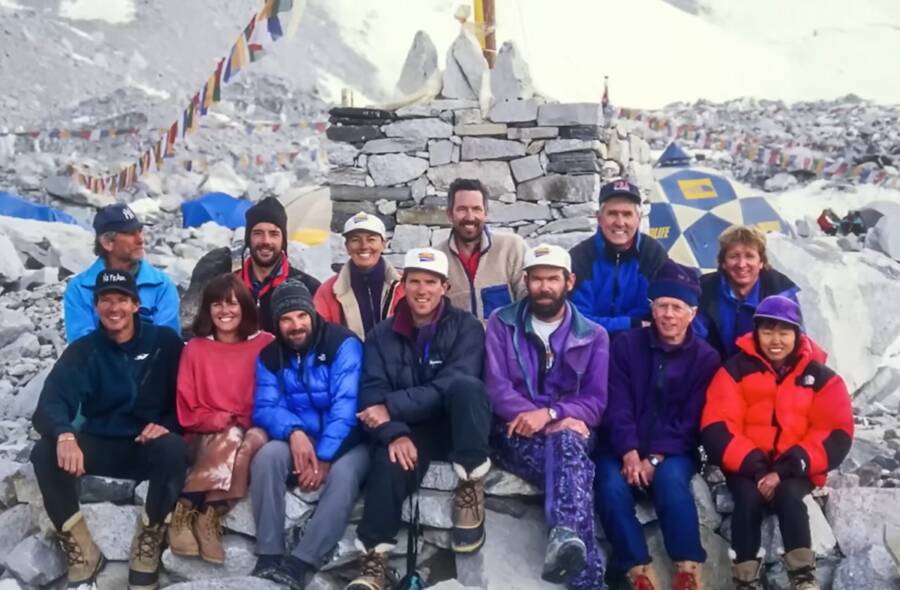
YouTubeRob Hall, in a purple outfit, with his clients and guides before the disaster attempt in 1996.
On May 10, 1996, Rob Hall and two guides were preparing to lead a group of eight clients up Mount Everest. Among the group were journalist Jon Krakauer, who would later write about the disaster in the book Into Thin Air, a postal worker named Doug Hansen, and Texas pathologist Beck Weathers. Weathers would barely survive the next 48 hours.
The group set out at midnight and quickly merged with another group led by Scott Fischer. There was a third group climbing that day, creating a traffic jam on Everest's south slope. There was only a narrow path here. Still, 33 people were trying to reach the summit.
The overcrowding caused dangerous delays; the unexpected need to set up fixed lines complicated matters. Meanwhile, Hall's group learned that Weathers was impaired due to recent cornea surgery. Hall ordered Weathers to stay behind, and the group continued without him.
They could not reach the summit after 2 PM, which jeopardized their descent. Leaving the summit after 2 meant they would not reach camp before nightfall, and descending the mountain in the dark was dangerous. Meanwhile, a storm had begun to gather, and the climbers soon faced freezing winds and whiteout conditions.
“There was chaos up there,” Krakauer recalled to Time magazine in 1996. “The storm was like a hurricane, but the wind chill was in the triple digits. You have no oxygen, you can’t breathe, you can’t think.”
Then Hansen collapsed. Rob Hall chose to stay with him while the rest of the group tried to descend the mountain slopes.
Rob Hall's Death on Mount Everest
At 4:30 PM, 16 of the 33 people attempting to summit Everest were stranded on the mountain; a powerful storm was battering the slopes with freezing winds of 70 miles per hour. Many from Hall's expedition were lost, including Hall himself. However, the next morning at 4:45, Hall managed to send a radio message to base camp.
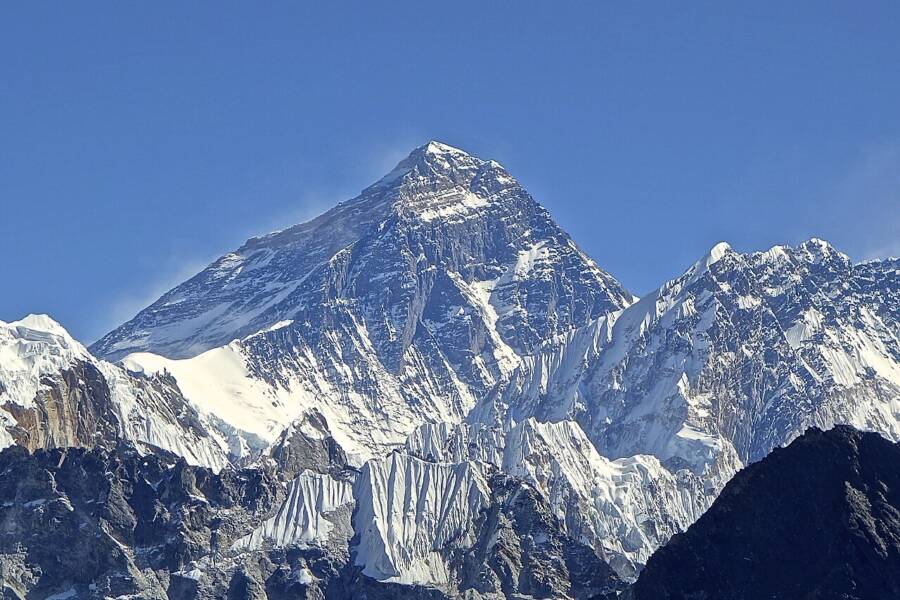
Rdevany/Wikimedia CommonsEven when the weather is clear, Mount Everest is fraught with dangers.
“Is anyone coming to get me?” he asked, according to Time in 2007.
Hall reported to base camp that Hansen had died overnight from exposure and lack of oxygen. Meanwhile, Hall was stranded and his condition was beginning to deteriorate. He told base camp, “I’m too clumsy to move.”
According to Time, rescue teams attempted to reach Hall twice but were unsuccessful. Another guide, Andy Harris, is also believed to have tried to reach Hall; his ice axe was later found near Hall's body, but Harris was lost on the mountain and was never found again.
“I will hold on,” Hall said when base camp informed him that a group of Sherpas could not reach him but had left a ski pole marker and oxygen tanks about 800 feet from his position.
However, no one knew the dangers of Everest better than Rob Hall.
In the end, he called his seven-month-pregnant wife and was able to speak with her one last time.
“Good night, my love,” he told her. “Please don’t worry too much.”
A short time later, Rob Hall died on the slopes at the age of 35. It is known that his body is still on Mount Everest.
He was not the only victim of the 1996 Everest Disaster. Eight climbers lost their lives that day; along with Hall, Hansen, Harris, and Hall's client Yasuko Namba, another expedition leader on the mountain, Scott Fischer, was also included. Meanwhile, Weathers had been left for dead but managed to descend to base camp. He survived but suffered horrific frostbite and ultimately had to undergo amputations of his nose, right arm, fingers on his left hand, and several parts of his feet.
Rob Hall's death and the 1996 Everest Disaster were a chilling reminder of nature's power. On the world's highest mountain, even experienced climbers can face danger and death.





Comments
(9 Comments)