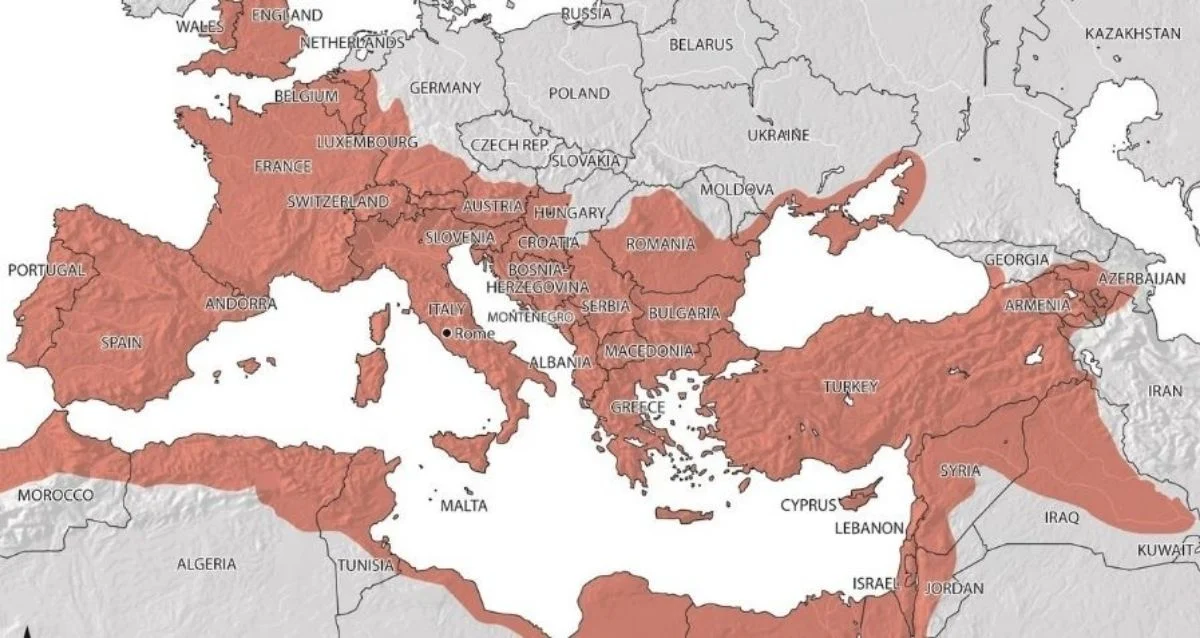
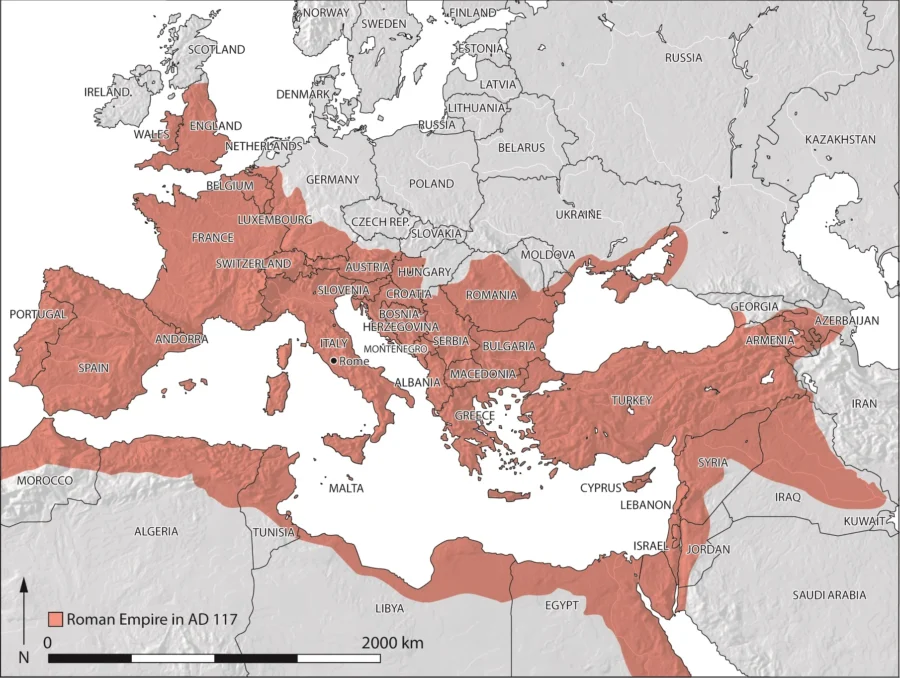
British MuseumThe exact size of the Roman Empire at its peak.
There are still traces of the Roman Empire in many parts of the world. Roman ruins in Africa, the Middle East, and Europe; crumbling arenas, cracked columns, and stone walls stand as reminders of the ancient superpower. So, how big was the Roman Empire?
The vast empire reached its peak in 117 A.D. and stretched from the northern border of England to North Africa, from the Atlantic Ocean in the west to the Persian Gulf in the east. Although it was not the largest empire in history, it was certainly impressive at the time.
However, its size ultimately led to its downfall. In the 4th century, the Roman Army began to withdraw from the more distant corners of the region to focus on threats to the heart of the empire. Then, in 286, the empire was permanently divided in two.
The Western Roman Empire fell in 476, marking the end of a power that once seemed unstoppable. However, the immense size of the Roman Empire made it one of the most famous territories in history.
Expansion Before the Roman Empire
According to legend, Rome was founded in 753 B.C. by Romulus, its first king. The Etruscans soon took control, but in 510 B.C., the Roman Republic was established. At this point, the Romans began to conquer their neighbors.
By 272 B.C., the entire Italian peninsula was under Roman control. In 241 B.C., at the end of the First Punic War against Carthage, the Romans captured Sicily, their first foreign territory. As Cicero later noted, Sicily was “the first place that taught our ancestors how glorious it is to rule over foreign nations.”
For two centuries, Rome continued to expand; first conquering Sardinia and Corsica, then turning to Spain, North Africa, and Anatolia. In a short time, almost all the lands around the Mediterranean became Roman.
During the Gallic Wars, between 58 and 50 B.C., Julius Caesar contributed to the empire by defeating the Gallic people (including modern-day France, Belgium, Luxembourg, and Switzerland). It is claimed that during one conquest in what is now Turkey, Caesar said, “Veni, vidi, vici,” meaning “I came, I saw, I conquered.” Of course, his later crossing of the Rubicon and declaring himself “dictator for life” led to his assassination in 44 B.C.
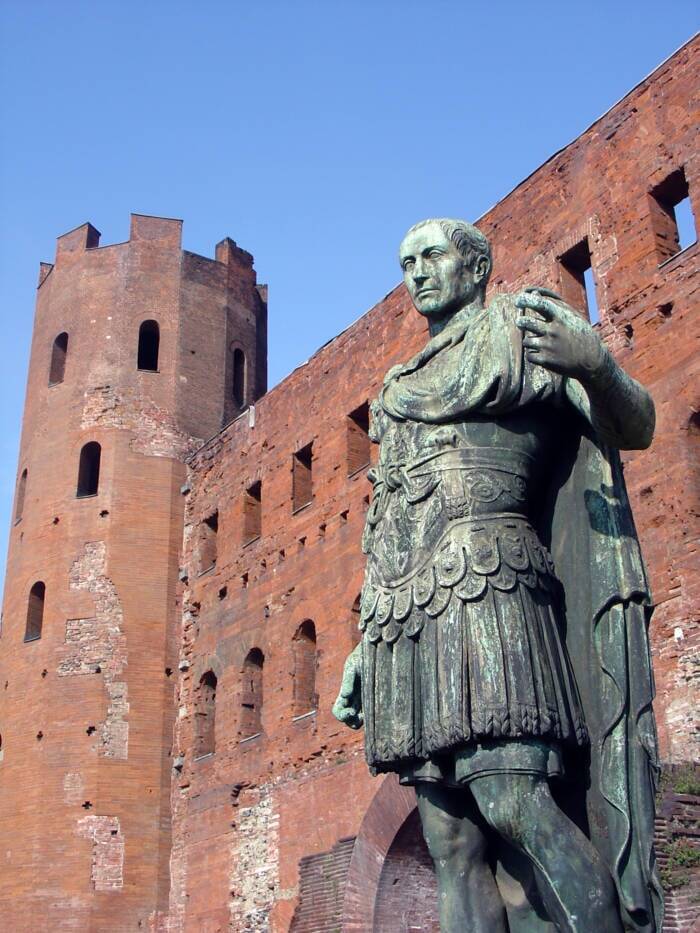
Anassagora/Wikimedia CommonsThe statue of Julius Caesar in the city of Turin, Italy.
One of Caesar's successors, Octavian, gained control of most of Egypt by defeating Mark Antony and Cleopatra at the Battle of Actium in 31 B.C. Four years later, the Roman Empire was officially established, and Octavian became the first emperor by taking the title Augustus.
So, how big was the Roman Empire when it reached its peak?
How Big Was the Roman Empire? The True Size at Its Peak
After Augustus took power, Rome experienced a period of peace and prosperity known as the Pax Romana, which lasted from 27 B.C. to 180 A.D. During this time, the empire continued to expand.
Emperor Claudius (41 A.D. - 54 A.D.) completed the work started by Caesar and conquered Britain, while Trajan (98 A.D. - 117 A.D.) added Dacia (modern-day Romania) and Parthia (parts of modern-day Iran and Turkmenistan) to Roman territory, extending the empire's borders to the Persian Gulf. Under Trajan, the size of the Roman Empire reached its peak.
Indeed, Hadrian (117 A.D. - 138 A.D.), one of Trajan's successors, set a boundary for the empire. He built Hadrian's Wall at the northernmost points of Roman territory, which was located on the border between England and Scotland.

Sémhur/Wikimedia CommonsThe Roman Republic and the Roman Empire expanded rapidly, which later contributed to the fall of Rome.
At this point, the size of the Roman Empire had reached incredible proportions. It had a population of at least 45 million and encompassed 50 modern countries. In terms of land, it covered nearly two million square miles — about half the size of the United States — stretching from Portugal to Mesopotamia, and from England to Africa.
However, the size of the Roman Empire would also be a significant factor in its downfall.
The Size of Rome Leading to Its Downfall
There were many issues that led to the fall of Rome, but the size of the Roman Empire was certainly a significant one.
Initially, Rome's vast territories were a source of pride for its citizens. The gradual conquest of lands in Europe, Africa, Asia, and the Middle East brought wealth, slave labor, and new cultures to the empire. However, when Rome's expansion came to a halt, these resources began to dwindle.
Meanwhile, although Rome had grown to protect itself, each conquered territory added an area that needed to be defended. More of its wealth began to be funneled into the empire's army, but military governance could only do so much. The distant provinces of Rome had become unmanageable.
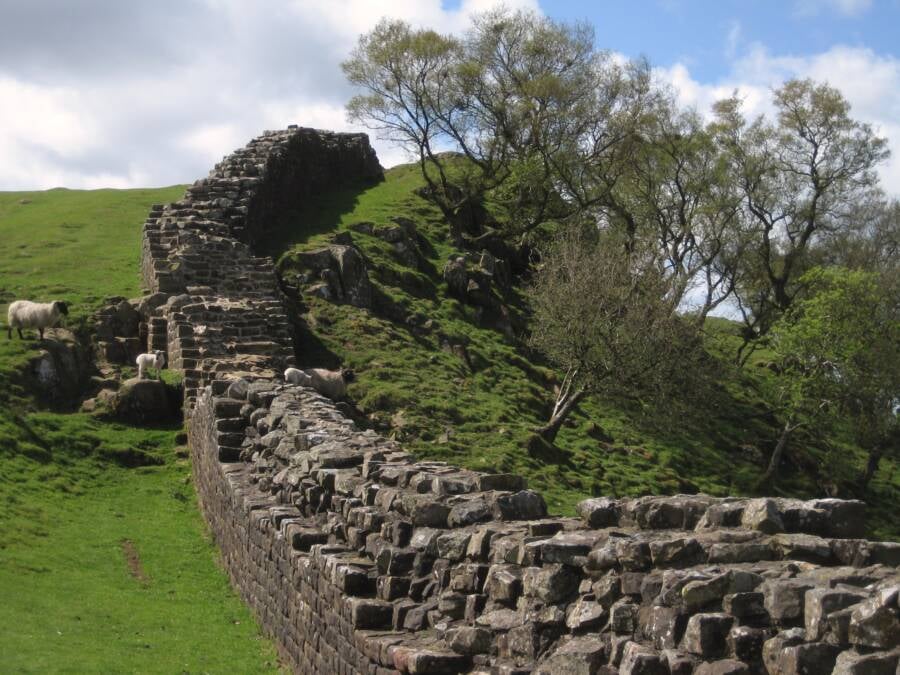
Johnnie Shannon/Wikimedia CommonsSome sections of Hadrian's Wall, which defined the northern borders of the Roman Empire, still stand in England today.
By the late 3rd century, Emperor Diocletian found a solution to the problem of Rome's size. He divided the empire into the Western Roman Empire and the Eastern Roman Empire. The center of the Western Roman Empire would be in Milan (with Rome maintaining its status as the "ceremonial" capital), and the center of the Eastern Roman Empire would be in Byzantium (later called Constantinople and then Istanbul).
Initially, it seemed that Diocletian had solved the problems arising from the size of the Roman Empire. However, the two empires gradually drifted apart, and the Western Roman Empire became increasingly shaken by attacks from Germanic tribes. In 476 A.D., the German leader Odoacer overthrew the emperor of Rome, Romulus Augustus, and the Western Roman Empire officially fell. Nevertheless, the Eastern Roman Empire continued until the 15th century (which is why there is some debate about when the Roman Empire fully fell).
So, how big was the Roman Empire? In fact, it did not grow as large as it was during Trajan's time, as wars and plagues decimated its population in the years following his rule. There have been larger empires throughout history, and many countries today have more citizens than Rome had; however, the Roman Empire still leaves a significant cultural impact. It not only covered a large part of the world but also left behind incredible traces of its lost power.
In the remnants of Rome that still exist today, we can see the greedy spread of the Roman Empire across the world.


















Comments
(10 Comments)